
How to Get Rid of Fungus Gnats: 3-Week Plan
Tiny black flies around your houseplants breed in damp compost, not dirt. Dry the surface, trap the adults and treat the larvae with nematodes or BTi — gone in three weeks.
This article contains affiliate links. We may earn a commission at no extra cost to you.
Quick Summary
Tiny black flies around your houseplants breed in damp compost, not dirt. Dry the surface, trap the adults and treat the larvae with nematodes or BTi — gone in three weeks. Those tiny black flies around your houseplants breed in permanently damp compost. Break the top-layer moisture, trap the adults and treat the larvae, and an infestation is gone in about three weeks.
What Fungus Gnats Actually Are
The small dark flies drifting up whenever you water a houseplant are fungus gnats — usually Bradysia species — and they are a symptom of wet compost, not dirty houses. Adults live about a week, fly badly, and are harmless: they don't bite, don't spread disease and don't eat leaves. The problem is underground. Each female lays up to 200 eggs in the top 2–3cm of moist compost, and the translucent larvae feed on fungi, decaying organic matter and, when populations are high, fine root hairs. On seedlings and cuttings that root damage is real and can stall or kill them; on an established monstera it's mostly a nuisance. The whole life cycle takes three to four weeks at UK room temperature, which is exactly why partial measures fail — kill the adults alone and a fresh batch emerges a fortnight later.
The Three-Week Elimination Plan
Day 1 — stop the watering routine
Let the top 3–5cm of compost dry completely between waterings. Push a finger in; if it's damp, wait. Dry surface compost is uninhabitable for eggs and young larvae, and this step alone breaks most infestations.
Day 1 — empty every saucer and cache pot
Standing water keeps the rootball saturated no matter how disciplined your watering is. Tip out saucers 20 minutes after watering, every time.
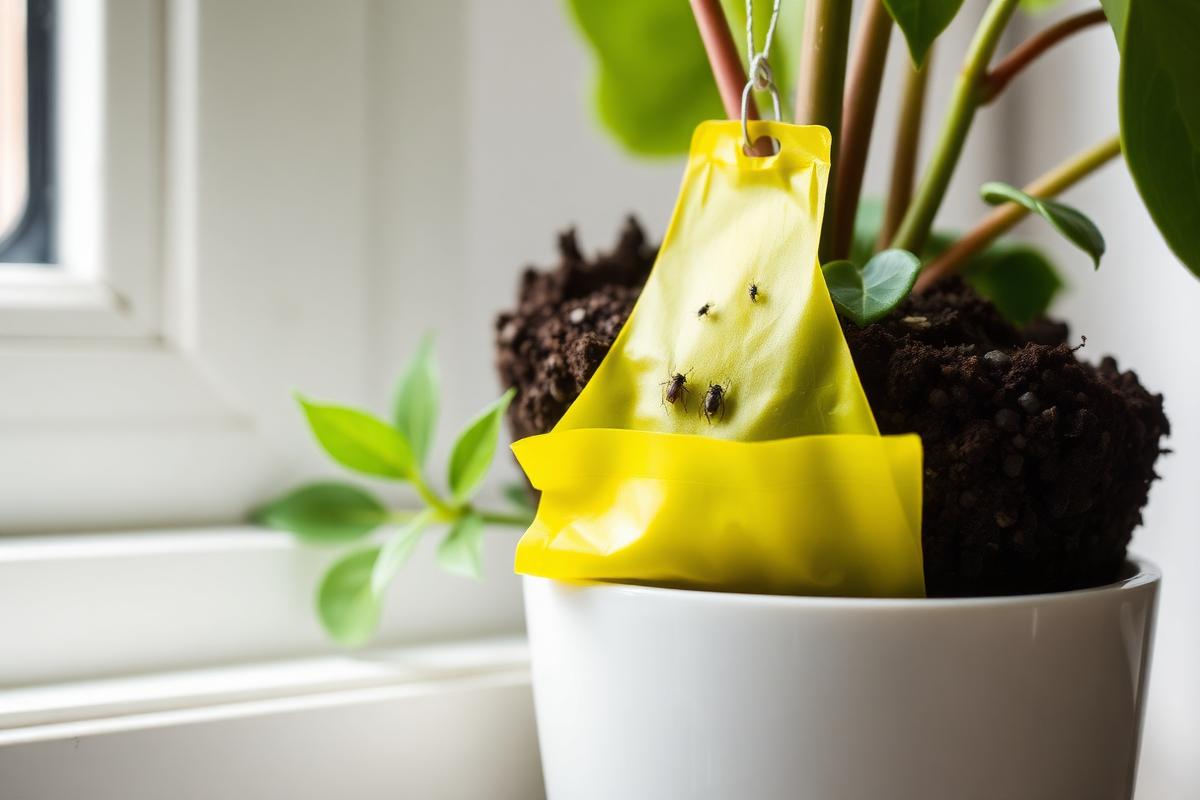
Day 1 — put up yellow sticky traps
One trap per pot, pushed in at compost level rather than up in the leaves — the adults fly low. These catch egg-laying females and give you a clear read on whether numbers are falling.
Day 2 — top-dress with a dry mulch
Cover the compost surface with 1–2cm of horticultural grit, coarse sand, perlite or LECA. It dries out fast, and females won't lay in it. This is the single most effective long-term fix.
Week 1 — treat the larvae
Water in either a nematode drench (Steinernema feltiae) or Bacillus thuringiensis israelensis (BTi), both widely sold in the UK. Nematodes need repeating after two weeks; BTi after seven days. Both are safe around pets and children.
Week 3 — check and repot the worst
Traps should be catching almost nothing. Any plant still producing flies likely has waterlogged, broken-down compost — repot it into fresh, gritty mix, washing most of the old compost off the roots.
What Actually Works — and What Doesn't
Grit or sand top-dressing
Highly effective and permanent. Denies females a damp surface to lay in. Costs a few pounds and never wears out.
Nematodes (S. feltiae)
The strongest larval treatment available to UK home gardeners. Store in the fridge, use before the date, apply to moist compost out of direct sun.
BTi (mosquito bits / gnat control)
A bacterial larvicide. Steep granules in the watering can or sprinkle on the surface. Cheap, effective, safe — repeat weekly for three weeks.
Yellow sticky traps
Won't clear an infestation alone but cut the breeding population fast and monitor your progress. Replace when covered.
Cinnamon and hydrogen peroxide
Partly effective at best. Peroxide drenches kill surface larvae on contact but do nothing to eggs deeper down, and repeated use can damage fine roots.
Bottom watering
Genuinely useful. Watering from a tray for 20 minutes keeps the top layer dry while the rootball drinks. Combine with a grit top-dressing and gnats rarely return.
Why They Appeared in the First Place
- ✓ Overwatering — by far the most common cause, especially in low-light UK winters when plants use far less water
- ✓ Peat-free composts, which hold more moisture and organic matter than old peat-based mixes
- ✓ Bringing a new plant home already carrying eggs in its compost — quarantine new arrivals for two weeks
- ✓ Open bags of compost stored damp in a shed or garage
- ✓ Pots without drainage holes, or decorative covers that trap water
- ✓ Dead leaves and spent flowers left on the compost surface, feeding the fungi larvae eat
Fungus Gnats in Greenhouses and Seed Trays
Indoors it's an irritation; in a propagator it's a genuine crop risk. Seedlings and cuttings have tiny root systems, and larval feeding on them shows up as inexplicable damping-off, stalled growth and wilting despite wet compost. In a UK greenhouse the answer is prevention: sow into fresh, sterile seed compost rather than reused mix, water from below wherever possible, ventilate whenever temperatures allow to dry the surface, and hang a sticky trap over each bench from February so you spot the first adults. If you're propagating seriously, apply nematodes preventatively at the start of the season rather than waiting for damage. Keep the greenhouse floor clear of old compost spills and abandoned pots — those are the reservoir the flies keep re-emerging from.
Common Mistakes
- ✗ Spraying the adults with fly killer and calling it done — the larvae are untouched
- ✗ Treating one plant and not the others in the same room; the adults simply move next door
- ✗ Letting compost dry so severely the plant wilts, which stresses roots and helps nothing
- ✗ Using nematodes past their expiry date or storing them at room temperature
- ✗ Repotting into the same wet, exhausted compost that caused the problem
- ✗ Giving up after two weeks — the cycle runs three to four weeks, so treatment must too
What to Buy to Clear an Infestation
A complete fungus gnat kit costs less than a decent houseplant: a pack of yellow sticky traps, a sachet of Steinernema feltiae nematodes or BTi granules, and a bag of horticultural grit or fine perlite for top-dressing. If several plants are affected, add a bag of good peat-free houseplant compost with extra perlite so you can repot the worst offenders rather than fighting them for months. A cheap moisture meter is optional but genuinely useful if you're the sort of plant owner who waters on a schedule instead of by feel.
Shop Sticky Traps, Nematodes & Horticultural GritRecommended Buying Guides
Looking for the right products? These guides have you covered:
Browse Pest Control on Amazon"Fungus gnats aren't a pest problem, they're a watering problem with wings. Fix the top three centimetres of compost and the flies have nowhere to breed."
— Sarah Mitchell, Home Gardening Pedia
Frequently Asked Questions
How do I get rid of fungus gnats in the UK quickly?
Let the top 3–5cm of compost dry out, top-dress with grit or perlite, hang yellow sticky traps at compost level and water in nematodes or BTi to kill larvae. Because the life cycle takes three to four weeks, keep all four measures going for at least three weeks.
Are fungus gnats harmful to plants?
Adults are harmless. The larvae feed on fungi and decaying matter but will eat fine roots when populations are high, which seriously affects seedlings, cuttings and small houseplants and can stall or kill them.
Does letting soil dry out kill fungus gnats?
It kills eggs and young larvae in the top layer and stops females laying, which breaks the cycle for most infestations. On its own it's slower than combining drying with a grit top-dressing and a larval treatment.
Do fungus gnats go away on their own?
Rarely, as long as the compost stays damp — indoor conditions let them breed year-round. They often decline naturally in summer when plants dry out faster between waterings, then return in autumn.
Is hydrogen peroxide safe for houseplants against gnats?
A one-part 3% peroxide to four-parts water drench kills larvae on contact and is generally tolerated, but it doesn't reach eggs deeper in the pot and repeated drenching can damage fine roots. Nematodes or BTi are more reliable.
Where do fungus gnats come from?
Almost always from the compost — either a new plant brought home with eggs already present, or an open bag of compost stored damp. Persistent overwatering is what turns a handful of flies into an infestation.
Written by
Sarah Mitchell
Senior Gardening Editor
Sarah has been gardening for over 15 years and holds an RHS Level 3 qualification. She specialises in organic growing methods and small-space gardening.
Related Articles
Best Slug Control Products for Gardens
Protect your plants from slugs and snails with these effective, wildlife-friendly control methods and products.
Natural Slug Repellents That Actually Work (UK Tested)
Forget coffee grounds and crushed eggshells — most natural slug deterrents are myths. We tested 12 popular methods on UK hostas over a wet spring. These are the four that genuinely stop slugs.